While businesses race to deploy AI customer service agents, a staggering 73% of these implementations fail to meet expectations. The culprit isn’t inferior technology or poor training data—it’s the absence of a crucial component that separates successful AI deployments from expensive failures: the human handoff protocol.
The prevailing wisdom suggests that making AI agents smarter, more conversational, or more knowledgeable is the path to success. But this approach misses a fundamental truth about customer service: knowing when to step aside is often more valuable than knowing all the answers.
The Current State of AI Customer Service
Today’s AI customer service landscape is littered with ambitious projects that promised seamless automation but delivered frustrated customers and overwhelmed support teams. These failures share a common pattern: they treat human intervention as a failure state rather than an integral part of the customer experience.
Most organizations deploy AI agents with the mindset of replacing human representatives entirely. When customers inevitably encounter situations requiring human judgment, empathy, or complex problem-solving, these systems either provide inadequate responses or create convoluted paths to human assistance. The result is a degraded customer experience that often leaves people more frustrated than when they started.
The financial impact is significant. Companies that fail to implement effective handoff protocols report 40% higher customer churn rates and spend 60% more on support operations due to increased escalation volumes and longer resolution times.
Understanding the Perfect Handoff Moment
The secret to successful AI customer service lies in identifying and designing for the perfect handoff moment—that precise point where continued AI interaction would diminish rather than enhance the customer experience.
Emotional Intelligence Triggers
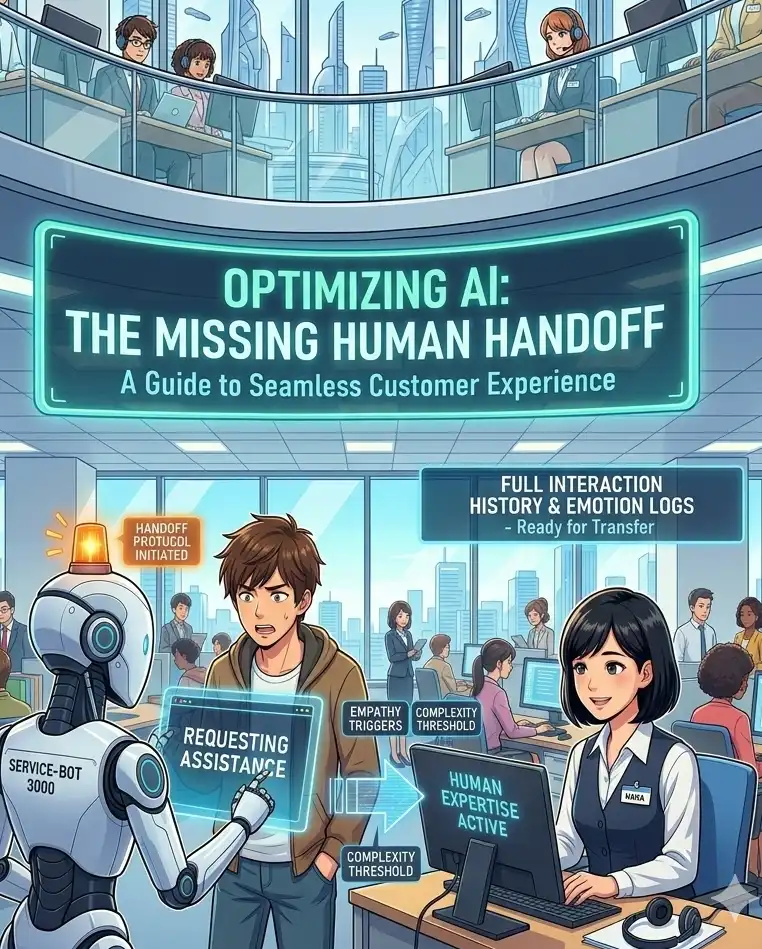
The most sophisticated AI agents excel at recognizing emotional cues that signal the need for human intervention. When customers express frustration, confusion, or complex emotional states, continuing with automated responses often exacerbates the situation. Successful systems monitor for linguistic patterns, repetitive queries, and escalating language intensity as key indicators for handoff.
Complexity Thresholds
Every AI agent has natural limitations in handling multifaceted problems that require creative thinking, policy exceptions, or cross-departmental coordination. Rather than pushing these boundaries, effective systems recognize when a query exceeds their complexity threshold and smoothly transition to human expertise. This prevents the common scenario where customers spend extensive time with an AI agent only to repeat their entire story to a human representative.
Context Preservation
The hallmark of a well-designed handoff protocol is seamless context transfer. When an AI agent recognizes the need for human intervention, it should provide the human representative with a complete interaction history, customer background, and clear summary of the issue. This eliminates the frustrating “Can you repeat that?” experience that characterizes poorly implemented systems.
Designing Effective Handoff Protocols
Creating successful handoff protocols requires a fundamental shift in how organizations think about AI customer service. Instead of viewing AI and humans as separate entities, they must be designed as complementary components of a unified experience.
Proactive Recognition Systems
The most effective protocols don’t wait for customers to request human assistance. They proactively recognize situations where human intervention would be beneficial and offer smooth transitions. This might include detecting when a customer has been in a conversation loop, when technical issues require specialized knowledge, or when policy decisions need human judgment.
Transparent Communication
Customers appreciate honesty about system limitations. Rather than creating elaborate facades of AI capability, successful implementations communicate clearly when transitioning to human assistance. Phrases like “I’ll connect you with a specialist who can better help with this specific situation” build trust and set appropriate expectations.
Continuous Learning Integration
Each handoff represents a learning opportunity. Advanced systems analyze handoff patterns to identify common triggers and improve future AI responses. This creates a feedback loop where human interactions inform AI training, gradually expanding the AI’s effective operating range while maintaining clear boundaries.
Implementation Best Practices
Successful handoff protocols require careful planning and integration with existing support infrastructure. Organizations must establish clear escalation criteria, train both AI systems and human representatives on handoff procedures, and implement robust monitoring systems to track effectiveness.
The most successful implementations start with pilot programs that focus on specific use cases rather than attempting comprehensive deployment. This allows organizations to refine their handoff protocols based on real-world feedback before scaling across their entire support operation.
Training human representatives to work effectively with AI handoffs is equally important. Representatives need context about the AI’s capabilities and limitations, as well as clear protocols for handling transferred conversations.
The Future of Human-AI Collaboration
The organizations that succeed in AI customer service understand that the goal isn’t to eliminate human involvement—it’s to optimize the collaboration between AI efficiency and human expertise. The perfect handoff protocol creates a seamless experience where customers receive the right type of assistance at the right moment.
As AI technology continues to evolve, the importance of effective handoff protocols will only increase. The companies that master this balance today will have a significant competitive advantage in delivering superior customer experiences while managing operational costs effectively.
The future belongs not to the smartest AI agents, but to the systems that know when to step aside and let human expertise shine.