
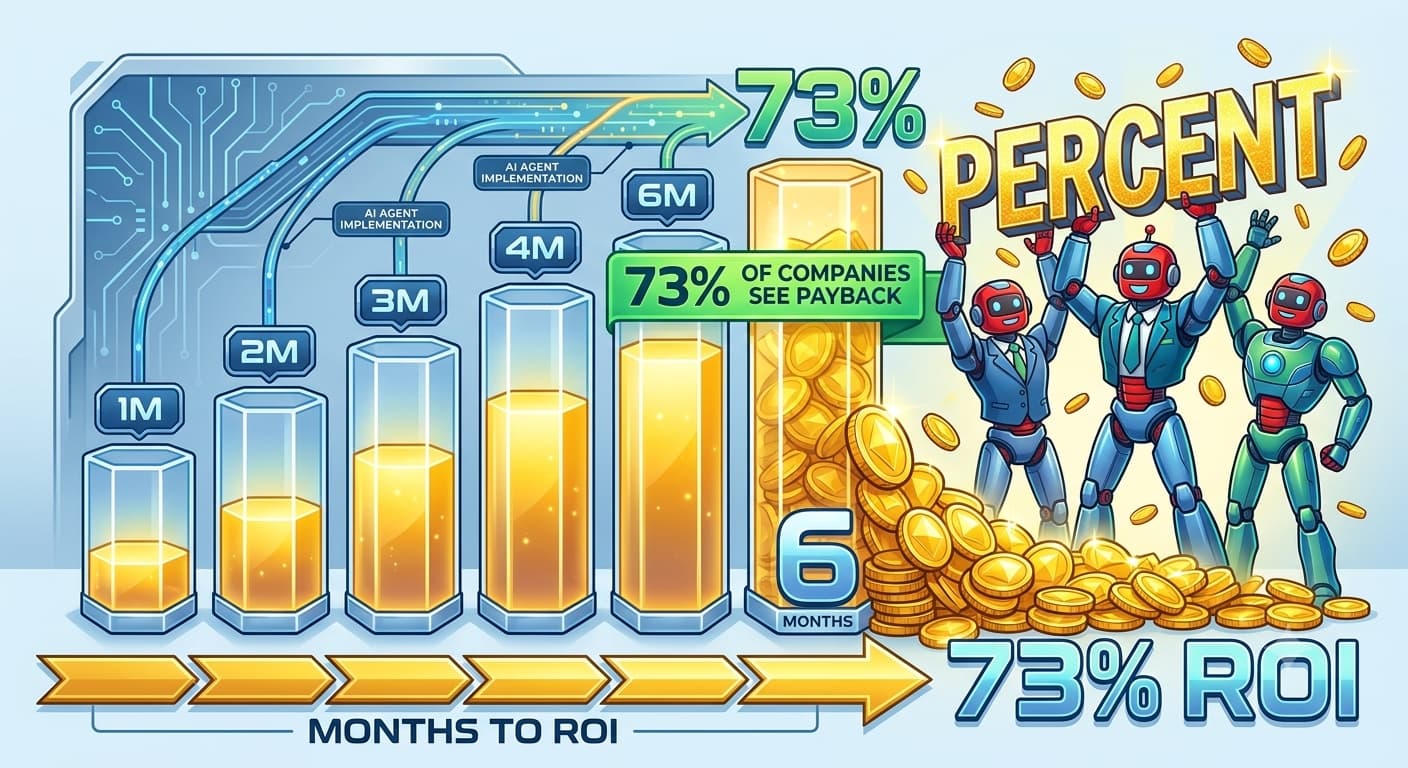
Salesforce’s Einstein AI agents now handle 60% of routine customer service inquiries, reducing response times from 24 hours to 3 minutes while cutting support costs by $50 million annually. This transformation illustrates why companies across industries are moving beyond AI experimentation toward full-scale agent deployment—and seeing measurable returns faster than expected.
The Economics Behind Agent Implementation
Recent research from McKinsey reveals that companies implementing AI agents see an average ROI of 280% within the first year. The key lies in understanding where agents deliver the highest value relative to implementation costs.
High-Impact, Low-Complexity Deployments
- Customer service automation: Average cost reduction of 30-50%
- Data entry and processing: 70-90% time savings
- Scheduling and appointment management: 60% efficiency gains
- Basic financial reconciliation: 80% error reduction
JPMorgan Chase’s COIN (Contract Intelligence) system exemplifies this approach. The legal document analysis agent processes in seconds what previously required 360,000 hours of lawyer time annually, generating $340 million in cost savings while reducing errors by 85%.
Revenue Generation vs Cost Reduction
While cost reduction drives initial adoption, revenue-generating applications often deliver higher long-term returns. Companies are discovering that agents excel at identifying opportunities humans miss.
HubSpot’s Revenue Operations Agent
HubSpot deployed an agent that analyzes customer behavior patterns to identify upselling opportunities. The system processes 50,000 customer interactions daily, flagging high-probability upgrade candidates with 78% accuracy. Sales teams report a 23% increase in deal size and 40% faster close rates when following agent recommendations.
Shopify’s Inventory Optimization
Shopify’s merchants using their inventory management agent report 15% higher profit margins through optimized stock levels and pricing recommendations. The agent analyzes 200+ variables including seasonal trends, competitor pricing, and supplier lead times to suggest inventory decisions that human managers couldn’t process at scale.
Implementation Costs: Reality vs Expectations
The barrier to entry for AI agents has dropped dramatically. What once required six-figure custom development can now be achieved with off-the-shelf platforms and strategic configuration.
Budget Breakdown for Mid-Market Companies
- Platform licensing: $5,000-15,000 monthly
- Integration development: $25,000-75,000 one-time
- Training and change management: $10,000-30,000
- Ongoing maintenance: 10-15% of initial investment annually
Zendesk’s agent marketplace demonstrates this accessibility. Companies can deploy pre-built customer service agents for $200-500 monthly, with most seeing positive ROI within 60 days. Insurance company Lemonade reduced claim processing costs by 70% using Zendesk agents, processing simple claims in under 3 seconds compared to 4 hours previously.
Measuring Success: Beyond Traditional Metrics
Successful agent implementations require new measurement frameworks that capture both quantitative and qualitative impacts.
Direct Financial Metrics
- Cost per transaction reduction
- Revenue per employee increase
- Processing time compression
- Error rate improvement
Strategic Impact Indicators
- Customer satisfaction scores
- Employee productivity gains
- Time-to-market acceleration
- Scalability improvements
Microsoft’s GitHub Copilot provides a compelling case study. While the tool costs $10 per developer monthly, studies show developers complete tasks 55% faster and report 88% higher productivity. For a 100-developer team, this translates to $2.4 million in annual productivity gains against $12,000 in licensing costs.
Common Implementation Pitfalls
Despite promising returns, 40% of agent projects fail to meet ROI expectations. Analysis of successful vs failed implementations reveals predictable patterns.
Process Selection Errors
Companies often target complex, exception-heavy processes first. Successful implementations start with high-volume, rule-based activities. American Express began with expense report processing—a clear workflow with defined outcomes—before expanding to more complex financial analysis tasks.
Integration Underestimation
The biggest cost overruns occur in system integration. Successful companies conduct thorough data audits before implementation. When Mastercard deployed fraud detection agents, they spent 40% of their budget on data cleaning and system integration—but achieved 67% better accuracy as a result.
The Compound Effect: Why Early Adopters Win
Companies implementing agents today are building competitive advantages that compound over time. As agents process more data, they become more accurate and valuable.
Netflix’s recommendation agents exemplify this dynamic. Early investment in recommendation technology now drives 80% of viewer engagement, contributing an estimated $1 billion annually to subscriber retention. Competitors attempting to replicate this capability face the challenge of training algorithms without years of behavioral data.
Building Your Business Case
Successful agent ROI stories share common elements that inform business case development:
Start Small, Scale Fast
Target processes generating $100,000+ in annual costs with clear success metrics. Document results rigorously to build momentum for larger initiatives.
Focus on Employee Augmentation
Position agents as productivity enhancers rather than job replacements. Companies report 60% higher adoption rates when framing agents as tools that eliminate mundane tasks.
Plan for Scale
Design architectures that can handle 10x growth in agent usage. Early infrastructure decisions determine whether initial success can expand organization-wide.
The evidence is clear: companies treating AI agents as strategic assets rather than experimental projects are achieving substantial returns within months, not years. As implementation costs continue falling and capabilities expand, the question isn’t whether to deploy agents—it’s how quickly you can realize their benefits before competitors do.