
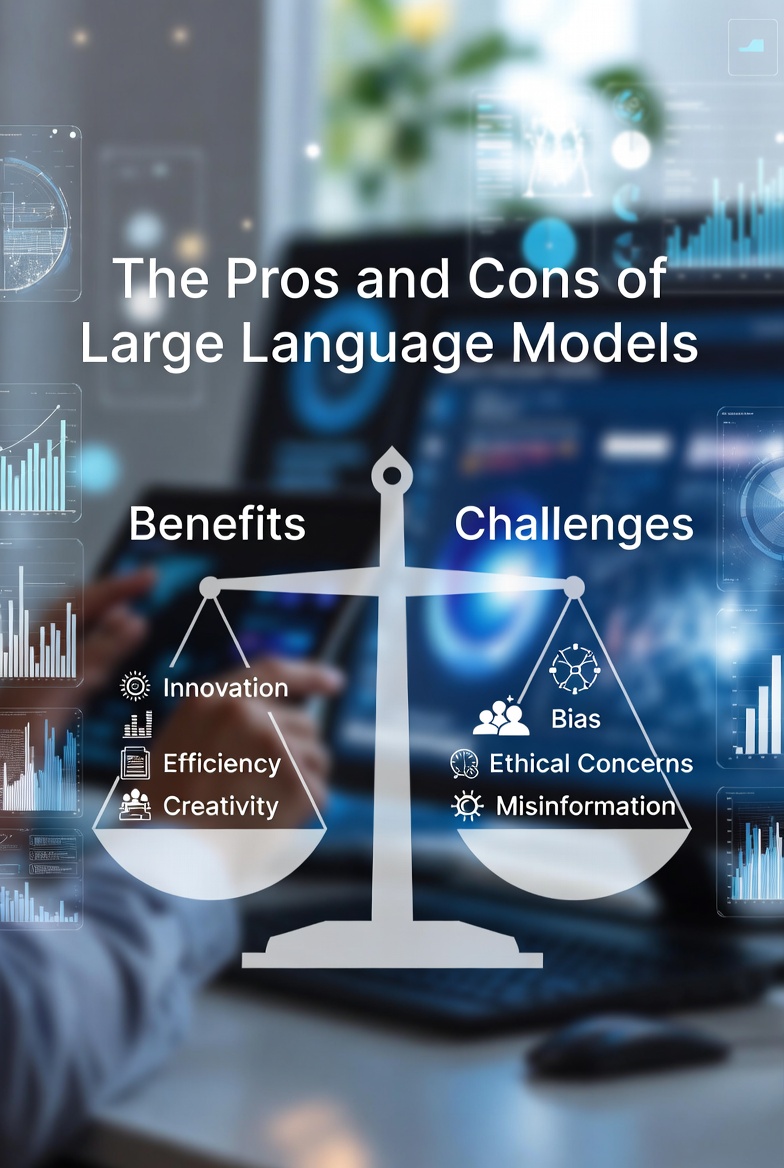
Large Language Models (LLMs) represent a significant advancement in artificial intelligence, leveraging vast datasets and sophisticated algorithms to process and generate human-like text. These models, such as GPT and BERT, have revolutionized natural language processing (NLP) by enabling machines to understand context, generate content, and interact in ways that mimic human communication. Trained on enormous corpora from the web and databases, LLMs use transformer architectures to capture relationships between words, providing unprecedented capabilities in various applications. However, while they offer transformative benefits, they also come with notable drawbacks, including ethical concerns and technical limitations. This essay explores the pros and cons of LLMs, drawing on their impacts across industries, development, and society.
One major advantage of LLMs is their ability to enhance efficiency and productivity. By automating tasks like code generation, data analysis, and document summarization, these models streamline workflows in sectors such as software acquisition and business operations. For instance, in defense software development, LLMs can accelerate processes that traditionally require extensive human effort, leading to faster outcomes and reduced costs. This efficiency extends to everyday development tools, where LLMs assist with auto-completion, writing documentation, and scaffolding tests, making them invaluable for programmers.
LLMs excel in natural language understanding and generation, unlocking applications like data extraction, translation, and dialogue facilitation. Their transformer-based architecture allows for high accuracy in NLP tasks, such as sentiment analysis and text classification, often outperforming traditional methods. Models like BERT demonstrate strong performance in classifying tasks with low memory requirements, making them accessible and easy to deploy on various devices. This capability fosters deeper comprehension and personalization in user interactions.
Another pro is the potential for innovation and optimization across domains. LLMs enable generative AI to produce swift, low-latency responses, supporting use cases from content creation to knowledge answering. In low-resource environments, they surpass smaller models, providing benefits in areas like speech recognition and language translation. Their ability to handle massive datasets promotes creativity and problem-solving, transforming how businesses approach human-computer communication.
LLMs also offer cost-effective solutions, with some models available for free and requiring minimal resources for fine-tuning. This democratizes access to advanced AI, allowing smaller organizations to leverage powerful tools without prohibitive expenses. In fields like environmental science, LLMs can aid in data analysis and risk assessment, highlighting their broad applicability. Overall, these models drive productivity gains and open new avenues for AI integration.
Despite these benefits, LLMs have significant limitations, including a lack of true contextual awareness and common-sense reasoning. They often struggle with nuanced understanding, leading to non-deterministic behavior where the same prompt yields varying or contradictory outputs. This unpredictability can undermine reliability in critical applications.
A prominent con is the propensity for hallucinations, where LLMs generate incorrect or fabricated information based on patterns rather than facts. Coupled with the spread of misinformation, this poses risks in areas like news dissemination or decision-making. Ethical concerns arise from biases inherited from training data, potentially amplifying societal inequalities.
Resource demands present another drawback, as training and deploying LLMs require vast computational power, raising environmental and energy consumption issues. Data security and transparency are also lacking, with models often operating as black boxes, making it difficult to audit decisions. Dependence on high-quality data further exacerbates these problems if the input is flawed.
Societal impacts, such as job displacement, highlight long-term cons, as LLMs could automate white-collar roles, leading to economic disruptions. In development contexts, over-reliance might stifle human creativity or skill development. Addressing these requires robust governance and ethical frameworks.
In conclusion, while LLMs offer groundbreaking pros in efficiency, innovation, and NLP capabilities, their cons—ranging from biases and hallucinations to resource intensity—demand careful consideration. Balancing these aspects will determine their future role in society, emphasizing the need for ongoing research and responsible deployment.