
When developers first encounter AI agents, the natural instinct is to build something impressive—a sophisticated multi-agent system that can reason, collaborate, and handle complex workflows. It’s an understandable impulse. After all, if AI can write code, analyze data, and engage in philosophical debates, why not create an army of intelligent agents working in harmony?
Here’s the counterintuitive truth: your first AI agent should be deliberately stupid. Not because AI isn’t capable of complexity, but because simplicity is the foundation of reliability. The most successful AI implementations in production today aren’t the ones that try to replicate human intelligence—they’re the ones that excel at a single, well-defined task.
The Complexity Trap: Why Multi-Agent Systems Fail
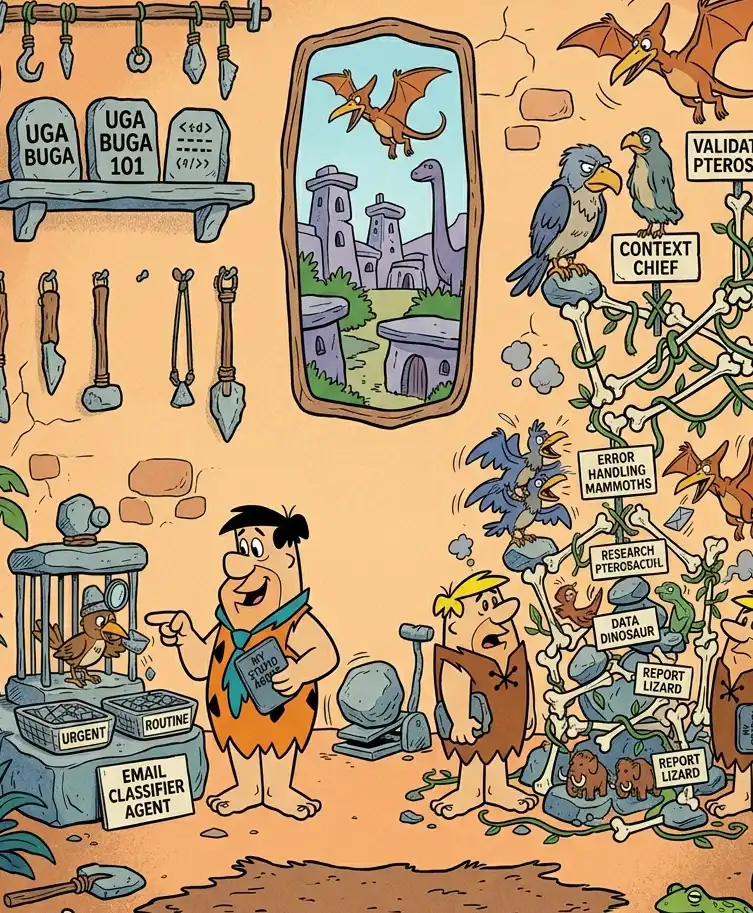
Multi-agent systems are seductive because they mirror how we think about teamwork. In theory, you could have one agent handle research, another manage data processing, and a third generate reports, all communicating seamlessly. In practice, this approach creates a cascade of potential failure points.
Each agent in a multi-agent system introduces uncertainty. Large language models are probabilistic by nature—they don’t always produce identical outputs for identical inputs. When you chain multiple agents together, these uncertainties compound exponentially. Agent A might produce slightly different results, causing Agent B to behave unexpectedly, which then confuses Agent C entirely.
The Communication Problem
Inter-agent communication adds another layer of complexity. Agents need to understand not just their task, but how to format their output for other agents, when to pass control, and how to handle edge cases. What happens when Agent A produces an output that Agent B can’t process? How do you debug a conversation between three different AI models?
These communication protocols require extensive prompt engineering, error handling, and validation—complexity that beginners often underestimate. The result is systems that work beautifully in demos but break unpredictably in real-world scenarios.
The Power of Single-Purpose Agents
A “stupid” AI agent isn’t actually unintelligent—it’s focused. It has one job, clear inputs, and predictable outputs. This constraint isn’t a limitation; it’s a superpower that enables reliability, debuggability, and optimization.
Consider a simple email classification agent. Its only job is to read an email and categorize it as “urgent,” “important,” or “routine.” This agent doesn’t need to understand the broader context of your business, coordinate with other systems, or make complex decisions. It just needs to be exceptionally good at email classification.
Benefits of the Single-Task Approach
Single-purpose agents offer several advantages that make them ideal for beginners:
Predictable Testing: With clear inputs and outputs, you can build comprehensive test suites. You know exactly what the agent should do with any given input, making it easy to identify when something goes wrong.
Easier Debugging: When a single-task agent fails, you have a limited scope to investigate. There’s no complex chain of agent interactions to trace through—just one model, one prompt, and one task.
Incremental Improvement: You can focus all your optimization efforts on perfecting one specific capability. Every prompt refinement, every training adjustment, and every validation rule directly improves your agent’s core function.
Clear Success Metrics: Simple agents have simple metrics. Your email classifier either gets the categorization right or wrong. There’s no ambiguity about whether the system is working.
Building Your First Stupid Agent
The best first AI agent solves a real problem you encounter regularly. Maybe it’s summarizing meeting notes, extracting key information from documents, or generating social media posts from blog content. The key is choosing something specific and measurable.
Start by defining your agent’s scope ruthlessly. If you’re building a document summarizer, resist the temptation to also make it extract action items, identify stakeholders, and schedule follow-up meetings. Those are separate agents for later.
The Implementation Process
Begin with the simplest possible implementation. Write a clear, specific prompt that describes the task, provides examples, and specifies the output format. Test it manually with various inputs to understand its behavior patterns.
Build robust input validation and output verification. Your agent should handle edge cases gracefully—what happens with empty inputs, extremely long documents, or content in unexpected formats? These safeguards are easier to implement and test with single-purpose agents.
Create a feedback loop for continuous improvement. Collect examples where the agent performs well and where it struggles. Use this data to refine your prompts and validation rules systematically.
When to Add Complexity
Once your single-task agent performs reliably in production, you’ll naturally identify opportunities for expansion. Maybe users want additional output formats, or you discover related tasks that could be automated. This is when you can consider adding complexity—but do it incrementally.
The path from simple to sophisticated should be evolutionary, not revolutionary. Add one new capability at a time, maintaining the same rigorous testing and validation standards that made your simple agent successful. Consider whether new features belong in your existing agent or warrant their own specialized agent.
Some teams eventually build orchestration layers that coordinate multiple single-purpose agents—but only after proving each component works independently. This approach gives you the benefits of specialization with the flexibility of composition.
Conclusion
The future of AI isn’t necessarily about creating general artificial intelligence that can do everything. It’s about building reliable, specialized tools that excel at specific tasks. Starting with “stupid” single-purpose agents isn’t settling for less—it’s building the foundation for systems that actually work in production.
Your first AI agent should be embarrassingly simple, almost boringly focused on one task. Give it clear boundaries, test it thoroughly, and optimize it relentlessly. Once you’ve mastered the art of building reliable single-task agents, you’ll have the skills and confidence to tackle more complex challenges. But you might be surprised to discover that your collection of focused, “stupid” agents outperforms any complex system you initially imagined building.