The software development landscape is rapidly evolving, with AI-generated code becoming increasingly prevalent. However, traditional debugging methods are struggling to keep pace with the volume and complexity of AI-produced outputs. Enter multi-agent debugging systems—a revolutionary approach where specialized AI agents work collaboratively to identify, analyze, and fix bugs in each other’s code, creating truly self-healing software ecosystems.
The Problem with Traditional Debugging in AI Development
As AI systems become more sophisticated, they’re generating code at unprecedented scales. Traditional debugging approaches, which rely heavily on human intervention and linear problem-solving methods, create significant bottlenecks in AI development workflows. Developers often spend 70-80% of their time debugging rather than creating new features, and this ratio becomes even more problematic when dealing with AI-generated code that may contain subtle logical errors or unexpected edge cases.
The challenge is compounded by the fact that AI-generated code often follows patterns that differ from human-written code, making it difficult for developers to quickly identify issues. Furthermore, as AI agents become more autonomous, the need for continuous code validation and improvement without human oversight becomes critical for maintaining system reliability and performance.
Architecture of Multi-Agent Debugging Systems
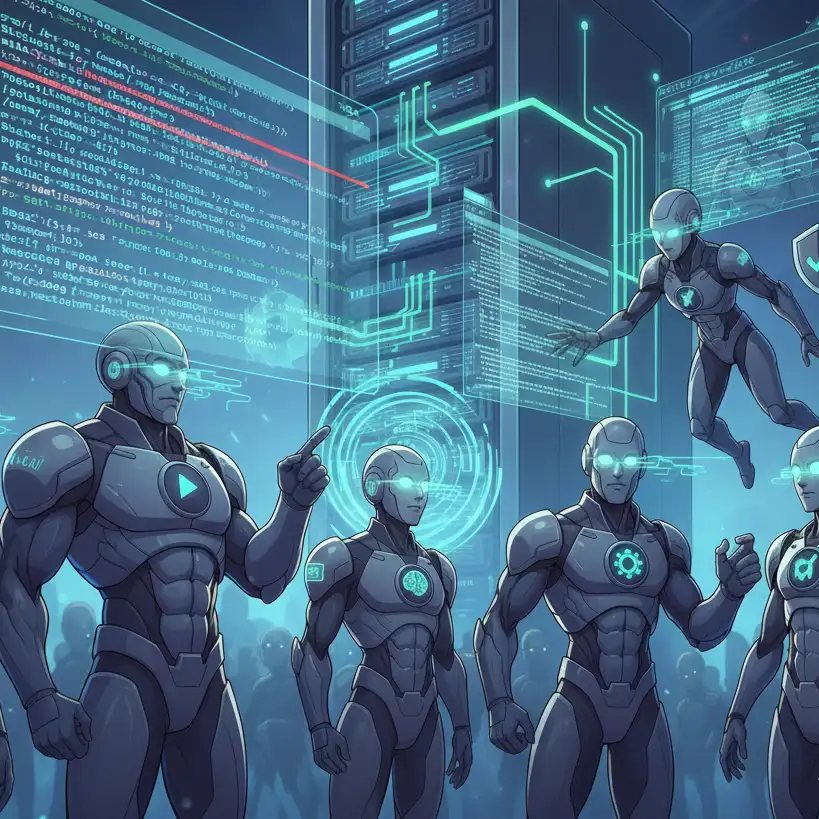
Multi-agent debugging systems operate on the principle of specialized collaboration, where different AI agents assume distinct roles in the debugging process. This distributed approach mirrors how human development teams organize around different expertise areas, but operates at machine speed with 24/7 availability.
The Detection Agent
The first layer consists of detection agents that continuously monitor code execution and outputs. These agents are trained to identify anomalies, performance bottlenecks, logic errors, and security vulnerabilities. They employ pattern recognition algorithms to spot deviations from expected behavior and can flag issues ranging from simple syntax errors to complex race conditions and memory leaks.
The Analysis Agent
Once an issue is detected, analysis agents take over to perform deep diagnostic work. These agents understand code structure, dependencies, and execution flows. They can trace bugs to their root causes, analyze the impact of potential fixes, and predict how changes might affect other parts of the system. Analysis agents maintain comprehensive knowledge bases of common bug patterns and their solutions.
The Repair Agent
Repair agents specialize in implementing fixes while maintaining code integrity. They generate multiple potential solutions, evaluate them against safety and performance criteria, and implement the most appropriate fix. These agents also ensure that repairs don’t introduce new bugs or break existing functionality through comprehensive testing protocols.
The Validation Agent
The final layer involves validation agents that verify fixes and monitor system behavior post-repair. These agents run extensive test suites, perform regression testing, and continuously validate that the implemented solutions are working as expected. They also feed learnings back into the system to improve future debugging cycles.
Collaborative Debugging Workflows
The true power of multi-agent debugging systems lies in their collaborative workflows. When a bug is discovered, agents communicate through structured protocols that ensure information flows efficiently between different specialists. This communication includes detailed context about the error, affected systems, potential impact, and suggested remediation strategies.
The collaborative approach enables agents to cross-validate each other’s work. For instance, when a repair agent suggests a fix, other agents can immediately evaluate its potential consequences across different system components. This peer-review mechanism significantly reduces the likelihood of introducing new bugs while fixing existing ones.
These systems also implement learning mechanisms where successful debugging patterns are shared across the agent network. When one agent discovers an effective solution to a particular type of bug, this knowledge becomes available to all other agents, creating a continuously improving collective intelligence.
Benefits and Real-World Applications
Multi-agent debugging systems offer compelling advantages over traditional approaches. They provide 24/7 monitoring and immediate response to issues, dramatically reducing system downtime. The distributed nature of the system means that debugging workload scales automatically with system complexity, and the continuous learning aspect means that common bugs get resolved faster over time.
Early implementations are already showing promising results in cloud infrastructure management, where agent systems monitor microservices and automatically resolve common deployment and configuration issues. In machine learning pipelines, these systems are being used to debug data processing workflows and model training processes, identifying and fixing issues that would traditionally require data scientist intervention.
The autonomous nature of these systems is particularly valuable in environments where rapid iteration is critical, such as A/B testing platforms and continuous deployment pipelines. By removing human debugging bottlenecks, development teams can focus on higher-level strategic work while maintaining confidence in system reliability.
The Future of Self-Healing Code
Multi-agent debugging systems represent a fundamental shift toward truly autonomous software development ecosystems. As these systems mature, we can expect to see them evolve beyond simple bug fixing to proactive code optimization, security hardening, and performance enhancement.
The implications extend beyond individual development teams to entire software ecosystems. Imagine open-source projects that continuously improve themselves, enterprise systems that adapt and optimize in real-time, and AI applications that become more robust through collective debugging intelligence.
While challenges remain—including ensuring agent coordination, managing complex debugging scenarios, and maintaining transparency in automated fixes—the potential for creating self-healing, continuously improving software systems makes multi-agent debugging one of the most promising frontiers in AI-assisted development. As we move toward an increasingly automated future, these collaborative debugging systems will likely become as essential as version control and testing frameworks are today.