
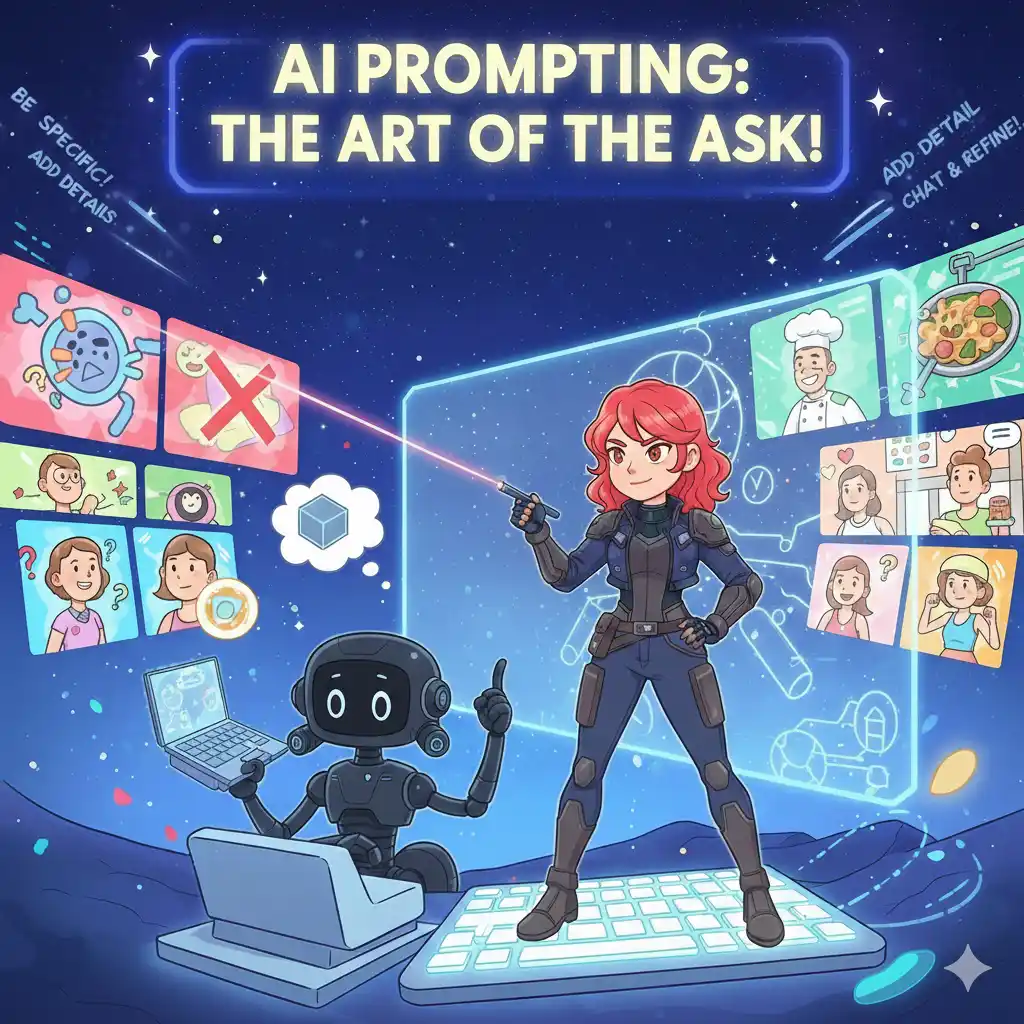
I. Introduction: The “Mind-Reading” Myth
- The Hook: Start with the frustration of getting a “robotic” or totally wrong answer from AI (e.g., “I asked for a recipe and it gave me a history of flour”).
- The Reality Check: Gently debunk the idea that AI is a mind-reader.
- The Analogy: Compare AI to a very talented, very fast, but incredibly literal intern. If you give vague instructions, you get vague results.
- The Promise: You don’t need a computer science degree; you just need to learn “The Art of the Ask.”
II. Tip #1: Give It a “Job Title” (The Persona)
- The Concept: Don’t just ask a question; tell the AI who it should be.
- Actionable Advice: Start prompts with “You are a…” (e.g., “You are a world-class travel agent” vs. “You are a frugal backpacker”).
- Why it works: It sets the “vibes” and vocabulary instantly.
- The “Funny” Example: Contrast “Write a workout plan” with “You are a terrifyingly enthusiastic 1980s aerobics instructor. Write me a 10-minute workout.”
III. Tip #2: Feed the Robot Context (The Background)
- The Concept: AI lives in a vacuum until you give it a world to live in.
- Actionable Advice: Use the “Who, What, Why” rule.
- Who is this for? (e.g., my 80-year-old grandma).
- What is the goal? (e.g., to explain how to use Zoom).
- Why are we doing this? (e.g., so she can see her grandkids).
- The “Aha!” Moment: More detail isn’t “clutter”—it’s a map.
IV. Tip #3: Use Your “Inside Voice” (Clear Constraints)
- The Concept: Be specific about what you don’t want and what the final product should look like.
- Actionable Advice: Set “Guardrails.”
- Length: “Under 100 words” or “Exactly three bullet points.”
- Tone: “Friendly but professional” or “Explain it like I’m five.”
- Format: “Put this in a table” or “Write this as a text message.”
- Humor: Mention how “Make it shorter” to an AI is like telling a toddler to “be quiet”—it needs a specific limit to actually work.
V. Tip #4: The “Monkey See, Monkey Do” Strategy (Examples)
- The Concept: If you want the AI to write like you, show it how you write.
- Actionable Advice: Paste a few sentences of your own writing and say, “Using the style of the text below, write a new paragraph about [Topic].”
- Practical Use: Great for emails, LinkedIn posts, or even birthday card messages that don’t sound like a Hallmark robot.
VI. Tip #5: Don’t Be a “One-and-Done” Prompter (Iteration)
- The Concept: Your first prompt is a conversation starter, not a final command.
- Actionable Advice: Treat it like a “chat.” If the answer is 80% there, give a follow-up:
- “That’s great, but can you make the second paragraph punchier?”
- “Take out the corporate jargon.”
- The Pro Move: Use the “Ask me questions first” trick. Tell the AI: “Before you write this, ask me 3 questions to make sure you have enough info.”
VII. Conclusion: You’re the Boss
- The Pep Talk: Remind them that they are in the driver’s seat. The AI is the engine, but they are the steering wheel.
- Final Thought: The more they practice, the more “natural” it feels.
- Call to Action: “Go try one of these tips right now—even if it’s just asking the AI to explain a movie plot in the style of a grumpy pirate.”