
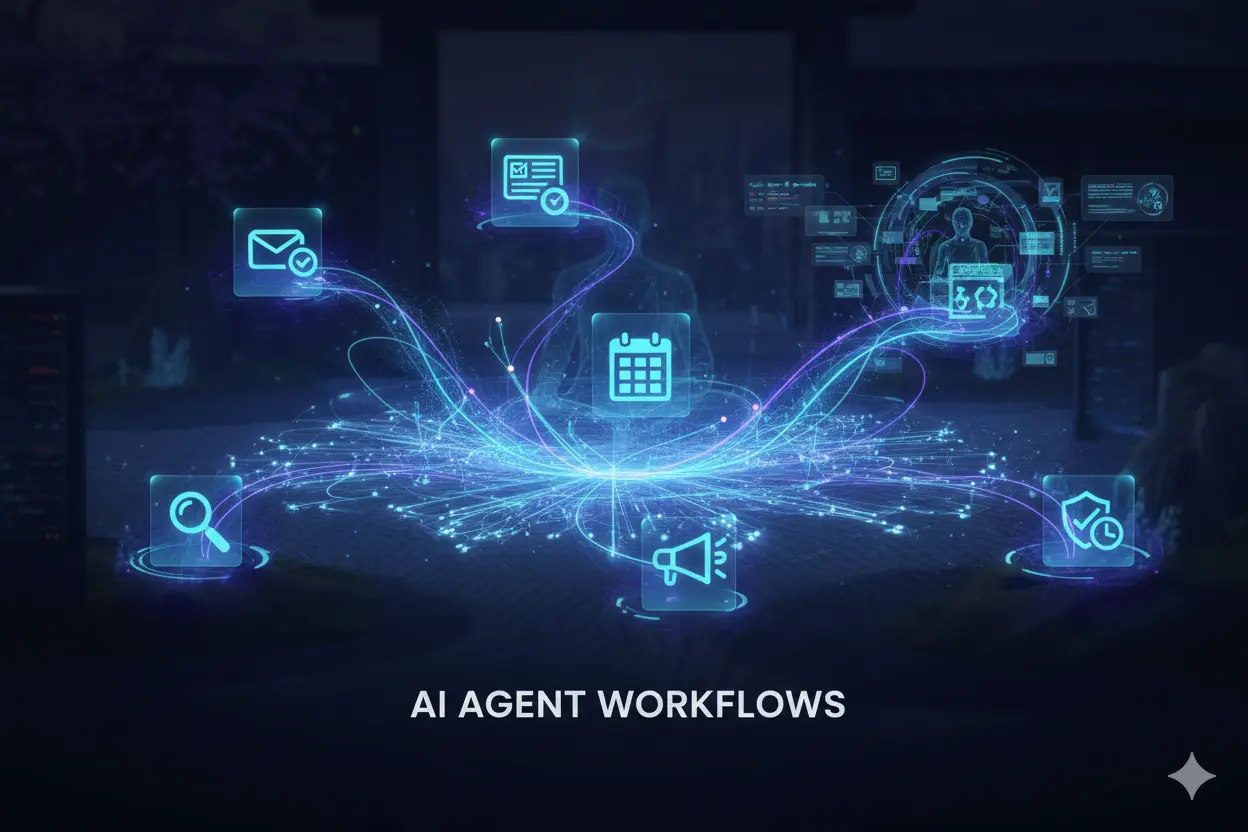
The promise of the “Information Age” was that technology would liberate us from the mundane, giving us more time for creativity and leisure. Instead, we find ourselves drowning in a sea of emails, Slack notifications, and repetitive administrative tasks. However, 2026 marks a turning point. We have moved beyond simple “chatbots” into the era of AI Agent Workflows.
Unlike a standard AI that simply answers questions, an AI Agent is proactive. It can use tools, browse the web, and execute a sequence of actions across different software platforms. By implementing these five specific agentic workflows, you can reclaim at least 10 hours of your work week.+1
1. The Autonomous “Inbox Zero” Agent
The average professional spends nearly 28% of their work week managing email. Most of this time is spent sorting through “noise”—newsletters, CC’d threads that don’t require action, and low-priority updates.
The Workflow:
An AI Agent connected to your Gmail or Outlook doesn’t just label your mail; it acts on it. Using a Large Language Model (LLM), the agent scans incoming mail and categorizes it into “Immediate Action,” “Needs Review,” or “Informational.”
- The Time Saver: The agent drafts responses to common inquiries based on your past sent folder. Instead of writing 50 emails, you simply spend 10 minutes approving 50 pre-written drafts.
- Estimated Saving: 3 hours per week.
2. The Research and Synthesis Specialist
Market research, competitor analysis, or simply staying updated on AI trends (like those we cover here at Agentica) can take hours of manual browsing.
The Workflow:
You can deploy an agent with “browsing” capabilities to monitor specific RSS feeds, Twitter lists, or news sites. When it finds a relevant article, it doesn’t just send you the link. It reads the article, extracts the data points most relevant to your specific business niche, and compiles a weekly “Intelligence Brief.”
- The Time Saver: Rather than losing 45 minutes every morning to “doom-scrolling” for news, you receive a five-minute summary that contains only what you need to know to make decisions.
- Estimated Saving: 2.5 hours per week.
3. The Meeting Lifecycle Manager
Meetings are often where productivity goes to die, primarily because of the “after-work”: summarizing notes, assigning tasks, and chasing people for updates.
The Workflow:
By integrating an AI agent into your video conferencing platform (like Zoom or Teams), you can automate the entire post-meeting cycle. The agent transcribes the audio, identifies the “action items,” and—this is the agentic part—automatically populates your project management tool (like Notion, Trello, or Asana) with those tasks.
- The Time Saver: It eliminates the “What did we decide?” follow-up emails. The agent can even send a gentle Slack nudge to a team member if a task hasn’t been started 48 hours later.
- Estimated Saving: 1.5 hours per week.
4. Content Repurposing Engine
For creators and marketers, the “blank page” is the biggest time-sink. Taking a single idea and turning it into a LinkedIn post, a newsletter, and a Twitter thread is exhausting manual labor.
The Workflow:
This agent workflow uses a “Chain of Thought” process. You feed the agent a single 10-minute voice memo of your ideas. The agent first transcribes it, then identifies the core “hook,” and finally generates five different content formats tailored to the tone and character limits of each platform.
- The Time Saver: It turns a 4-hour content creation session into a 20-minute “review and edit” session. It maintains your “voice” while handling the formatting and structural heavy lifting.
- Estimated Saving: 2 hours per week.
5. Personal “Gatekeeper” and Scheduler
The “back-and-forth” of scheduling—“Does Tuesday at 4 work for you?” “No, how about Wednesday at 10?”—is a cognitive tax we shouldn’t be paying in 2026.
The Workflow:
An AI scheduling agent acts as a true executive assistant. It has access to your calendar and understands your “Deep Work” preferences. If someone requests a meeting, the agent checks if the person is a priority contact. If they are, it offers slots. If they aren’t, it politely requests an agenda first to see if the matter can be handled via email.
- The Time Saver: It protects your focus time from being fragmented by low-value meetings and handles all the coordination logistics without you seeing a single “scheduling” email.
- Estimated Saving: 1 hour per week.
The Bottom Line: Moving from Doing to Directing
The cumulative effect of these workflows is more than just a 10-hour gain; it is a shift in your professional identity. When you implement AI Agent Workflows, you stop being a “doer” of repetitive tasks and start being a “director” of digital systems.
At Agentica, we believe that mastering these workflows is the single most important skill of the next decade. The technology is no longer a luxury for the tech-savvy; it is a necessity for anyone who wants to remain competitive while keeping their sanity in an increasingly fast-paced world.