
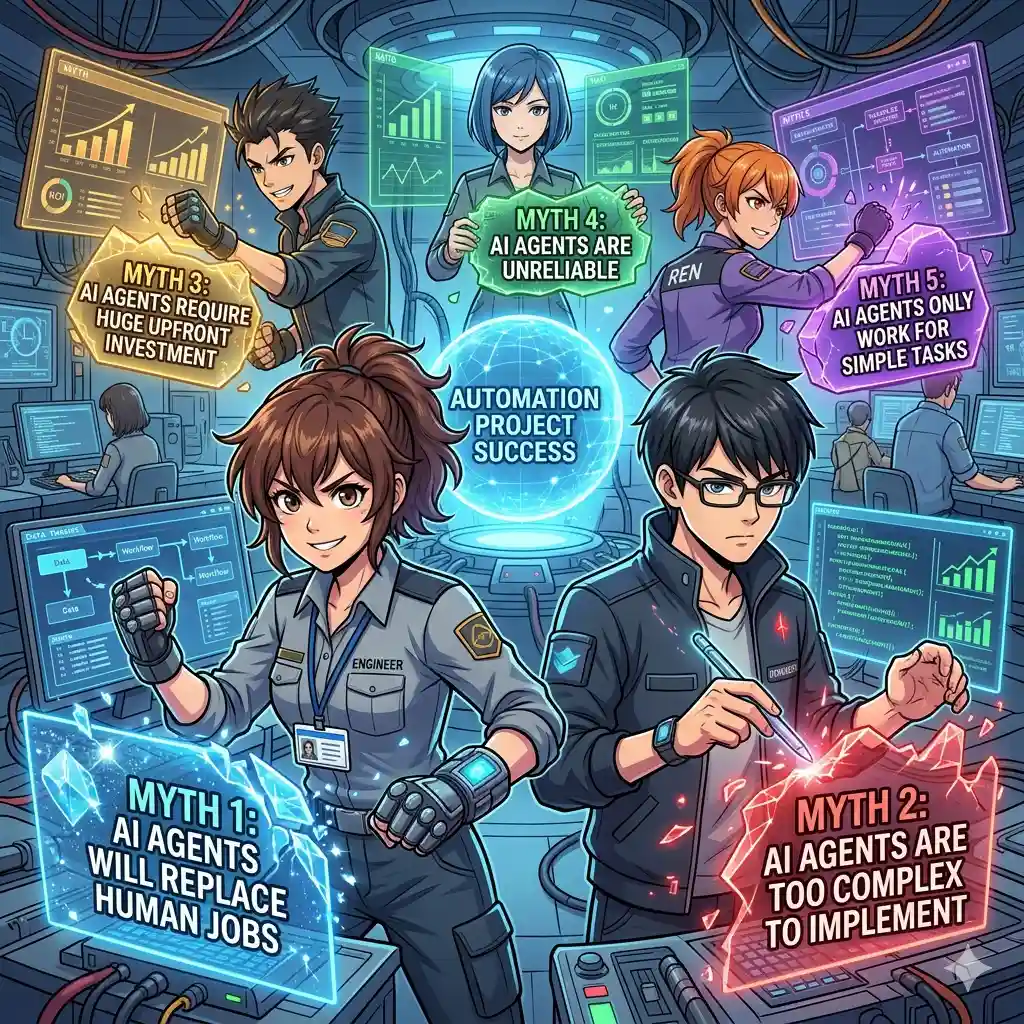
After building and deploying dozens of AI agents across enterprise environments, I’ve noticed the same misconceptions surfacing in every planning meeting. These myths aren’t just wrong—they’re actively sabotaging automation initiatives and burning budgets on overcomplicated solutions.
Myth 1: AI Agents Need to Be Autonomous to Be Valuable
The biggest misconception I encounter is that agents must operate independently to justify their existence. Teams spend months building elaborate decision trees and fail-safes, trying to create fully autonomous systems that can handle every edge case.
In practice, the most successful agents I’ve deployed operate in supervised autonomy mode. Take our customer service agent at a SaaS company—it handles 80% of tier-1 tickets automatically but escalates complex billing disputes to humans. This hybrid approach processes 3x more tickets than pure automation while maintaining quality standards.
The sweet spot isn’t full autonomy. It’s identifying the 70-80% of routine tasks where agents excel, then building clean handoff mechanisms for exceptions. Tools like LangGraph make this trivial with their human-in-the-loop nodes, but teams often skip this feature chasing the autonomous dream.
Myth 2: You Need Custom LLMs for Effective Agents
Engineering teams frequently assume they need fine-tuned models or custom training data to build capable agents. I’ve watched companies spend six months training domain-specific models when off-the-shelf solutions would have shipped working systems in weeks.
Most successful agents I’ve built use GPT-4 or Claude with carefully crafted prompts and retrieval-augmented generation (RAG). For a legal document processing agent, we achieved 94% accuracy using Claude with a well-structured knowledge base—no custom training required.
The real leverage comes from prompt engineering, tool integration, and data pipeline design. Companies like Harvey AI built their legal AI platform primarily on foundation models, focusing their engineering effort on user experience and workflow integration rather than model training.
Save custom model development for scenarios where you have massive proprietary datasets and clear competitive advantages. Most use cases don’t meet this bar.
Myth 3: Agents Should Replace Human Workers
The replacement narrative dominates agent discussions, creating unnecessary resistance from teams who should be your biggest advocates. I’ve seen promising agent projects die because they were framed as job elimination rather than capability enhancement.
Effective agents augment human capabilities rather than replacing them entirely. Our sales qualification agent doesn’t replace SDRs—it pre-qualifies leads, researches prospects, and drafts personalized outreach templates. SDRs now focus on relationship building and deal progression instead of data entry.
This augmentation approach yields better adoption rates and business outcomes. When agents handle routine tasks, humans tackle higher-value work that drives revenue and innovation. The most successful deployments I’ve managed positioned agents as productivity multipliers, not replacements.
Myth 4: Multi-Agent Systems Are Always Better
The allure of multi-agent architectures leads teams to build unnecessarily complex systems. I regularly see architectures with 5-7 specialized agents when a single well-designed agent would be more effective and maintainable.
Multi-agent systems introduce coordination overhead, debugging complexity, and failure cascades. For content generation, teams often create separate agents for research, writing, editing, and publishing. In practice, a single agent with access to the right tools and a well-structured workflow performs better and fails less frequently.
The exception is when you have genuinely distinct domains requiring different expertise. CrewAI excels in scenarios like software development where you need separate agents for coding, testing, and documentation—but most business use cases don’t require this complexity.
Start with single agents. Add complexity only when you hit clear performance or architectural limits.
Myth 5: Agent Performance Is All About the LLM
Teams obsess over model selection and parameters while neglecting the infrastructure that actually determines agent reliability. The most common failure mode I observe isn’t LLM errors—it’s integration breakdowns, data quality issues, and poor error handling.
Agent performance depends more on:
- Data pipeline reliability—stale or inconsistent data kills agent accuracy
- Tool integration robustness—API timeouts and rate limits cause more failures than model errors
- Monitoring and observability—you can’t improve what you can’t measure
- Graceful degradation—how agents behave when external dependencies fail
We’ve deployed agents running on GPT-3.5 that outperform GPT-4-based systems because they have better data pipelines and error handling. The infrastructure matters more than the model in production environments.
Building Agents That Actually Work
These myths persist because they sound sophisticated and align with sci-fi expectations of AI. But real-world agent success comes from understanding your specific use case, starting simple, and iterating based on actual user feedback.
Focus on solving concrete business problems with the simplest possible architecture. Build monitoring and human oversight from day one. Most importantly, position agents as productivity enhancers rather than replacements—your team’s adoption rates will thank you.